 Image 1 of 1
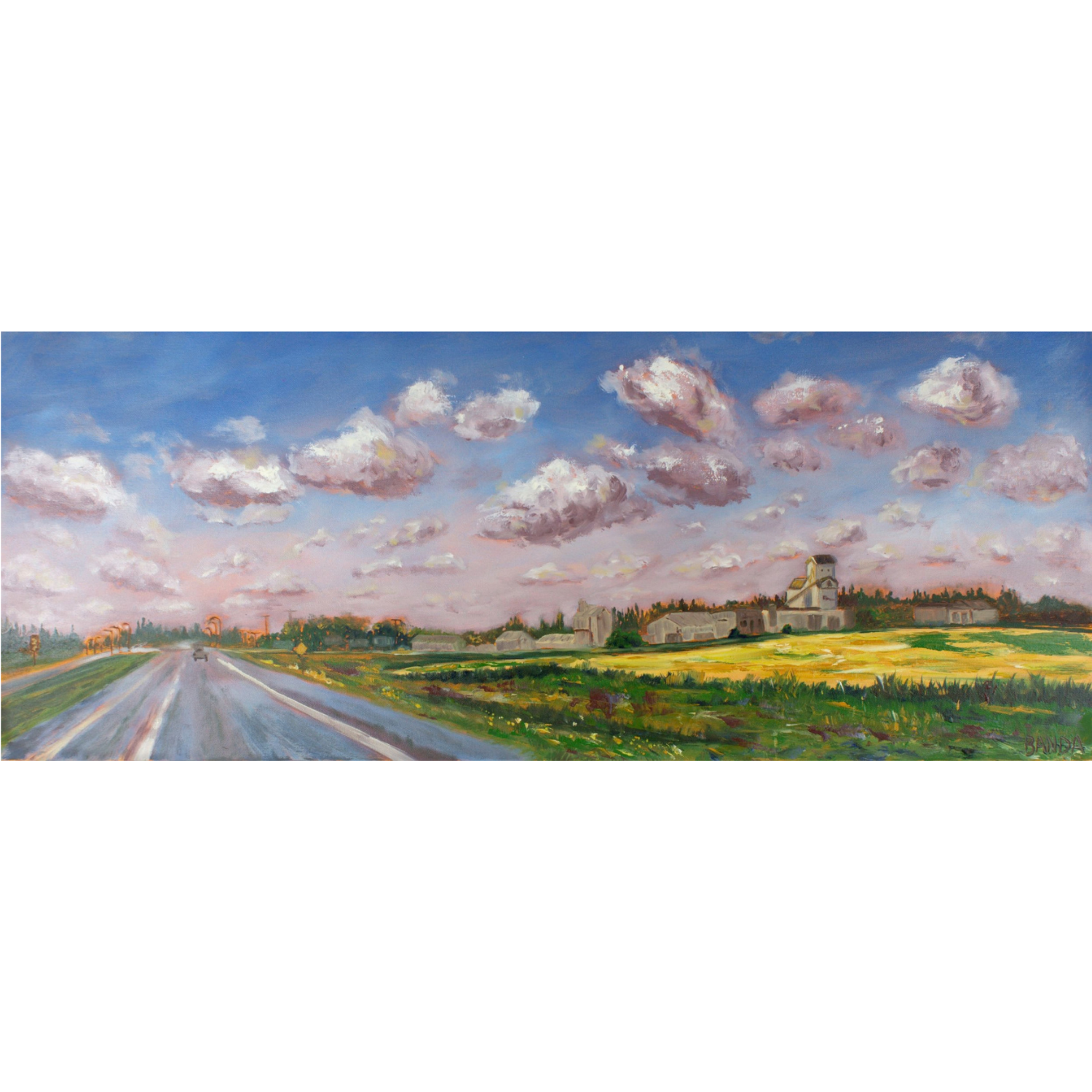
The Road Home catches the last warm hour of a prairie afternoon, when the light has gone golden along the horizon and the sky fills with soft, rounded cloud, gathered as though to meet the traveller. That warmth comes down through the painting rather than sitting on top of it: a loaded brush leaves the cloud unhurried and lit cream and rose along its tops, the canola is brushed in quickly enough that its green and gold are still moving, and the road is blended smooth and cool against all that texture, carrying the eye toward a small town assembling itself on the horizon beneath a white grain elevator.
Those two shapes — a canola field in full colour and an elevator standing above the treeline — do something for a Saskatchewan viewer that no amount of description can replace. They are recognized in the body before they are named, and they arrive carrying the whole physical memory of coming home: the slowing down, the loosening of the hands on the wheel, the arithmetic of distance giving way to the certainty of arrival. Given both distance and a destination, the eye stops searching and simply travels — the settling NeuroArts attends to, held here by an elevator standing as a landmark rather than a subject, the sign that the miles out and the miles back are nearly accounted for and the week that required them nearly closed.
Everything in the painting bends toward arrival: the comfort of a place that knows you are coming, a horizon holding something familiar rather than something unknown, and the quiet permission such a place offers once you reach it. The going can stop now, the day can be set down, and you are welcome to stay awhile.
Details
Oil painting on canvas
Unframed
Ready to hang
Dimensions in inches: 40 wide x 16 high
Ships with tracking number via courier.
The Road Home catches the last warm hour of a prairie afternoon, when the light has gone golden along the horizon and the sky fills with soft, rounded cloud, gathered as though to meet the traveller. That warmth comes down through the painting rather than sitting on top of it: a loaded brush leaves the cloud unhurried and lit cream and rose along its tops, the canola is brushed in quickly enough that its green and gold are still moving, and the road is blended smooth and cool against all that texture, carrying the eye toward a small town assembling itself on the horizon beneath a white grain elevator.
Those two shapes — a canola field in full colour and an elevator standing above the treeline — do something for a Saskatchewan viewer that no amount of description can replace. They are recognized in the body before they are named, and they arrive carrying the whole physical memory of coming home: the slowing down, the loosening of the hands on the wheel, the arithmetic of distance giving way to the certainty of arrival. Given both distance and a destination, the eye stops searching and simply travels — the settling NeuroArts attends to, held here by an elevator standing as a landmark rather than a subject, the sign that the miles out and the miles back are nearly accounted for and the week that required them nearly closed.
Everything in the painting bends toward arrival: the comfort of a place that knows you are coming, a horizon holding something familiar rather than something unknown, and the quiet permission such a place offers once you reach it. The going can stop now, the day can be set down, and you are welcome to stay awhile.
Details
Oil painting on canvas
Unframed
Ready to hang
Dimensions in inches: 40 wide x 16 high
Ships with tracking number via courier.